In most projects, waste management is addressed late in the design process. Floor plans are finalized. Public spaces are defined. Circulation paths are locked in. Only then does the conversation turn to where waste will go and how it will be handled.
This approach treats waste as a service to accommodate rather than infrastructure to design. The result is often compromised solutions that create operational challenges long after construction is complete.
As hospitals and cities become denser and more complex, waste infrastructure can no longer be an afterthought.
How Late-Stage Waste Planning Creates Long-Term Problems
When waste systems are designed around leftover space, inefficiencies are built in from day one. Chute rooms are squeezed into tight areas. Waste carts share corridors and elevators. Dumpsters are placed wherever access is available, even if it disrupts operations or public areas.
These decisions may seem minor during planning, but their impact compounds over time. Odor issues, overflow, safety risks, and increased labor become part of daily operations. Staff spend time managing waste rather than focusing on higher-value work.
Once a building or district is operational, correcting these issues is difficult and costly.
Waste Touches Every Part of a Facility
Unlike many systems, waste is generated everywhere. Patient rooms, kitchens, public spaces, retail areas, and offices all produce waste throughout the day. How that waste moves affects cleanliness, safety, and user experience across the entire environment.
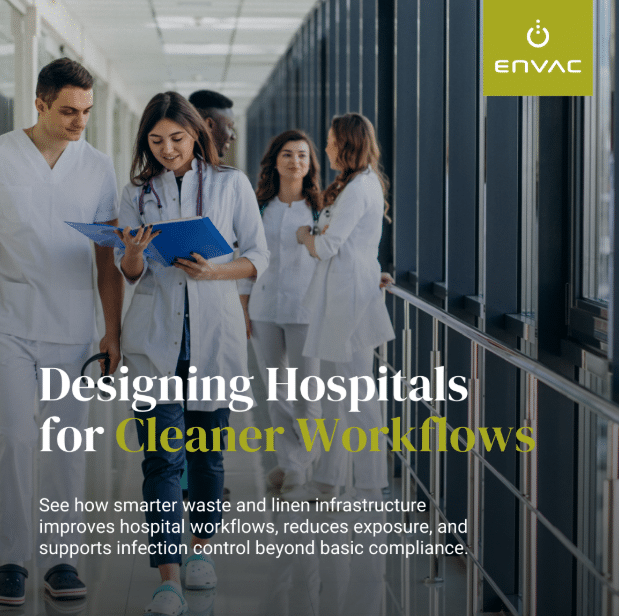
In hospitals, manual waste and linen transport increases contact points and infection risk. In cities and mixed-use developments, surface-level collection introduces noise, congestion, and visual clutter.
These impacts extend far beyond the waste room or loading dock.
Why Infrastructure Thinking Changes the Outcome
Utilities such as water, sewer, and power are planned early because they are essential to daily operations. Waste should be treated the same way.
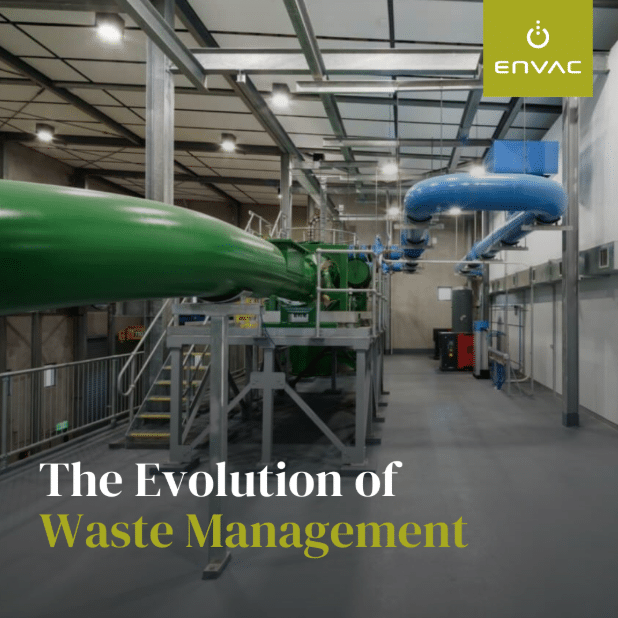
Automated waste collection systems embed waste transport into the built environment. Waste is deposited at designated inlets and moved through sealed underground or enclosed pipes to centralized collection points. This removes the need for carts, shared holding rooms, and frequent truck access.
Envac’s automated waste collection systems are designed to operate as fixed infrastructure rather than external services. Learn how automated waste collection works:
https://www.envacgroup.com/what-we-do/automated-waste-collection-system/
Benefits of Early Integration
When waste infrastructure is planned early, projects gain flexibility instead of constraints. Inlets can be placed near points of generation. Collection areas can be located away from public or clinical spaces. Pipe routes can be coordinated with other building systems.
This approach reduces manual handling, improves hygiene, and frees up valuable space that would otherwise be dedicated to waste rooms or staging areas.
For cities and large developments, early integration also reduces internal truck traffic and supports cleaner, more walkable environments.
Supporting Long-Term Performance and Resilience
Infrastructure decisions made during planning shape operations for decades. Systems that rely heavily on manual handling and surface transportation are vulnerable to disruption from weather, labor shortages, and changing regulations.
Automated systems provide predictable performance and reduce dependence on ideal conditions. Waste continues to move even when truck access is limited, supporting resilience and continuity.
Envac’s experience supporting long-term municipal and district-scale systems can be explored here:
https://www.envacgroup.com/us/envac-city/
A Smarter Way to Plan
Waste infrastructure influences safety, cleanliness, labor efficiency, and public perception. Treating it as an afterthought limits what a project can achieve.
By giving waste infrastructure a seat at the planning table, hospitals and cities can design environments that function better from day one and adapt more easily over time. Automation is not just a technology choice. It is a planning decision that shapes how spaces perform for years to come.