The Hidden Risk of Moving Waste Through Healthcare Facilities
Waste does not just exist in a hospital. It moves through it.
Every day, waste and soiled linens are transported through corridors, elevators, and shared spaces. These movements are part of normal operations, but they introduce risks that are often overlooked.
The problem is not the waste itself. It is how it moves.
Waste Movement Creates Exposure Points
In many healthcare facilities, waste is moved manually using carts. These carts travel through hallways, pass through doors, and share elevators with staff and visitors.
Each step in that process creates a new touchpoint. Surfaces are contacted. Spaces are shared. Materials move through areas that were never designed for waste transport.
Even when protocols are followed, the movement itself introduces opportunities for contamination.
Infection Control Does Not Stop at Disposal
Hospitals invest heavily in infection prevention. Cleaning protocols, PPE, and sanitation standards are carefully maintained.
But waste movement is often treated as a separate operational task rather than part of infection control strategy.
When waste is transported through active environments, the pathway becomes part of the risk. The longer materials remain in shared spaces, the greater the exposure potential.
Manual Movement Adds Complexity to Daily Operations
Moving waste manually requires time, coordination, and labor. Staff must navigate busy corridors, avoid peak traffic, and manage transport without disrupting care.
This adds complexity to workflows that are already demanding. It also increases the number of interactions between waste and the environment.
Over time, these repeated movements create both operational strain and increased risk.
How to Evaluate Risk in Your Facility
Most facilities already have risk built into their waste movement, but it is not always visible.
High-traffic corridors, shared elevators, and temporary staging areas are all common points where exposure increases. The challenge is identifying where those risks exist and how often they occur.
A structured evaluation is the first step toward reducing unnecessary movement and improving safety.
Containing Movement Reduces Risk
The most effective way to reduce exposure is to limit how waste moves through occupied spaces.
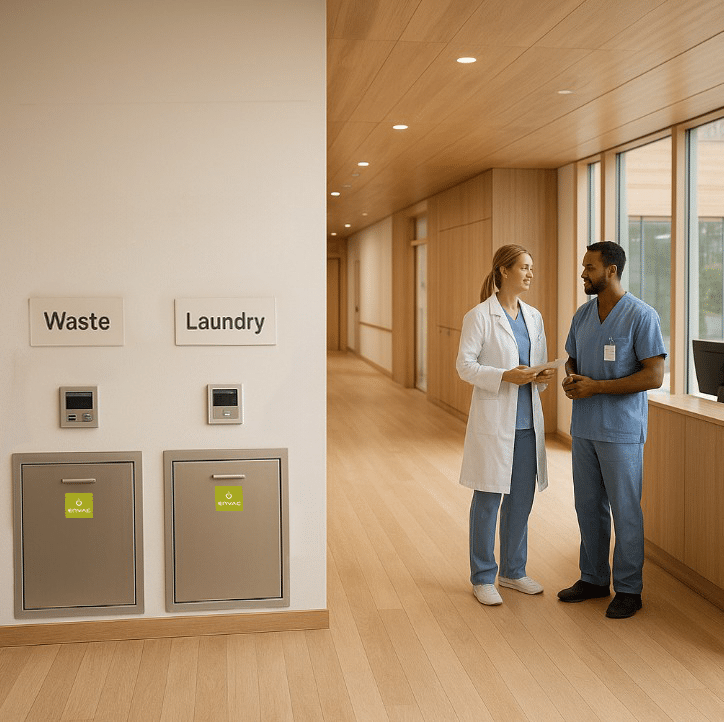
When waste is contained and transported through sealed infrastructure, it no longer shares pathways with patients, staff, and visitors. Movement becomes controlled, predictable, and isolated from daily operations.
This approach reduces touchpoints and removes waste from the environments where cleanliness is most critical.
Rethinking Waste as a Flow, Not a Task
Waste management is often viewed as a series of tasks. Collect, move, dispose.
But in reality, it is a continuous flow through the building. Every movement affects safety, cleanliness, and efficiency.
When that flow is not designed properly, risk is built into daily operations.
Start Reducing Risk Today
Waste movement cannot be eliminated, but it can be controlled.
Facilities that take a proactive approach to evaluating and improving movement pathways reduce contamination risk, simplify operations, and create safer environments for both staff and patients.
Healthcare Sustainability Upgrades & Retrofit
The Hidden Risk of Moving Waste Through Healthcare Facilities
Related articles
Healthcare Sustainability Upgrades & Retrofit
Why Waste Planning Should Happen Before Floor Plans Are Finalized
Every successful development starts with a series of decisions. Where amenities will be located. How residents will move through the building. Where mechanical systems belong. /../
Healthcare Sustainability Upgrades & Retrofit
How Waste Infrastructure Impacts Project Economics
Every major design decision has financial consequences. Developers carefully evaluate unit mix, amenity packages, parking ratios, and building systems because each one affects the long-term /../

Healthcare Sustainability Upgrades & Retrofit
Designing Residential Towers for People, Not Waste
Great residential buildings are designed around the people who live in them. Developers invest heavily in amenities, thoughtful layouts, natural light, outdoor spaces, and shared /../