Envac has signed an extended contract with Tuna Entreprenad (the project’s main contractor) for Eskilstuna Strängnäs Energy and Environment’s (ESEM) optical sorting plant. The collaboration includes both the modification and expansion of the existing facility and a clear commitment to increasing capacity and sorting efficiency. It is an important step in further strengthening the municipality’s already leading position in recycling and resource-efficient waste management.
A pioneer in property-close collection and optical sorting
Eskilstuna was an early adopter of property-close collection for its residents. When national recycling targets were tightened, the municipality chose as early as 2010 to switch to an optical sorting solution from Envac.
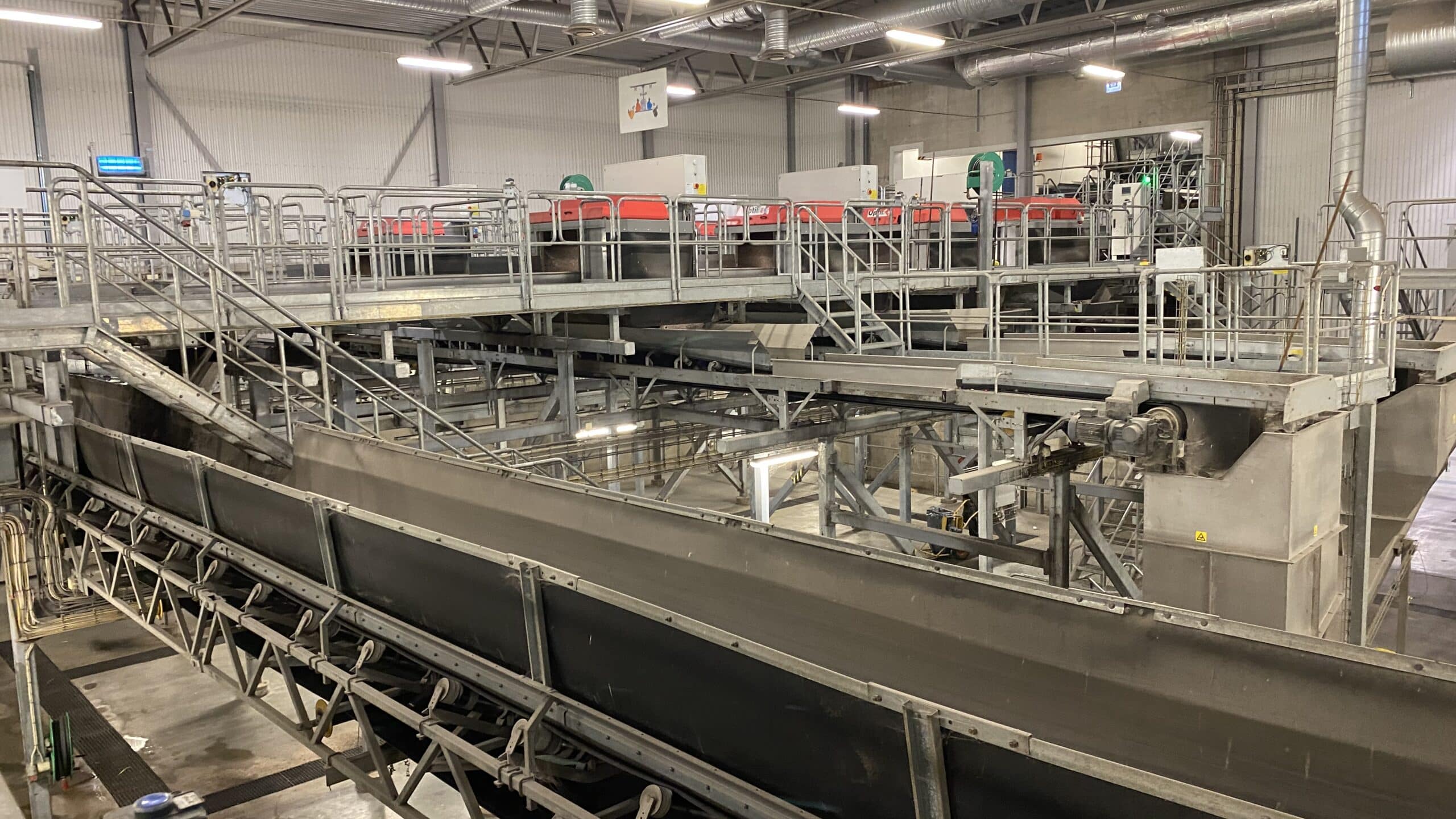
Today, six different fractions are sorted at the plant, which is owned and operated by ESEM: residual waste, paper packaging, metal packaging, newspapers, plastic packaging and food waste. The facility has a capacity of around 14,000 bags per hour, equivalent to approximately 30,000 tonnes per year, and currently serves Eskilstuna, Strängnäs, Örebro and a number of municipalities in the Stockholm area.
Next step in a long-term partnership
The new agreement between Envac and Tuna Entreprenad includes the modification and expansion of the existing sorting plant, with the aim of both increasing capacity and improving sorting efficiency.
- Demolition work will start in December 2025, and installation will take place during the spring and autumn of 2026.
- The upgraded plant is expected to be commissioned in Q4 2026.
- With upgraded technology, improved control systems and increased capacity, the conditions are created to connect more municipalities to the system over time.
- The plant already handles bags from several municipalities today, but with the expanded capacity, the opportunity opens up for even more to join an established and proven optical sorting solution.
- As municipalities across the country face stricter requirements for property-close collection (FNI) and the associated challenges of implementation, logistics and economics, optical sorting is becoming a very attractive alternative.
- By collecting multiple fractions in colour-coded bags and sorting them at a central facility, high levels of material recycling can be achieved without the need to expand local bin systems or make major interventions in existing infrastructure.
The purpose of the new agreement is to ensure a robust, flexible and future-proof solution for the collection and sorting of household waste, in line with the government’s new waste reforms and upcoming requirements on material recycling and resource efficiency.
Eskilstuna has long been a frontrunner in modern waste management and material recycling. The fact that we are now trusted to both extend and expand our collaboration is clear proof that our optical sorting solution creates real value for the municipality, its residents and the climate. Together with ESEM, we will continue to further develop a robust, future-proof system that makes it easier to achieve higher recycling rates and take the next step in the circular transition.
John Seiger, Envac
Through the extended contract, Envac and Eskilstuna are creating the conditions for an even higher degree of material recycling, better data quality and more circular resource flows. At the same time, the municipality is well prepared for the stricter requirements in national waste policy.
With a proven optical sorting facility, where new fractions have already been tested, and with a forthcoming increase in capacity, Eskilstuna has a stable platform to meet future demands for sustainable waste management and property-close collection – not only for the municipality itself, but also as a resource for other municipalities in the region.